All content and media files are published under a Creative Commons Attribution-ShareAlike 4.0 International License (CC BY-SA 4.0)

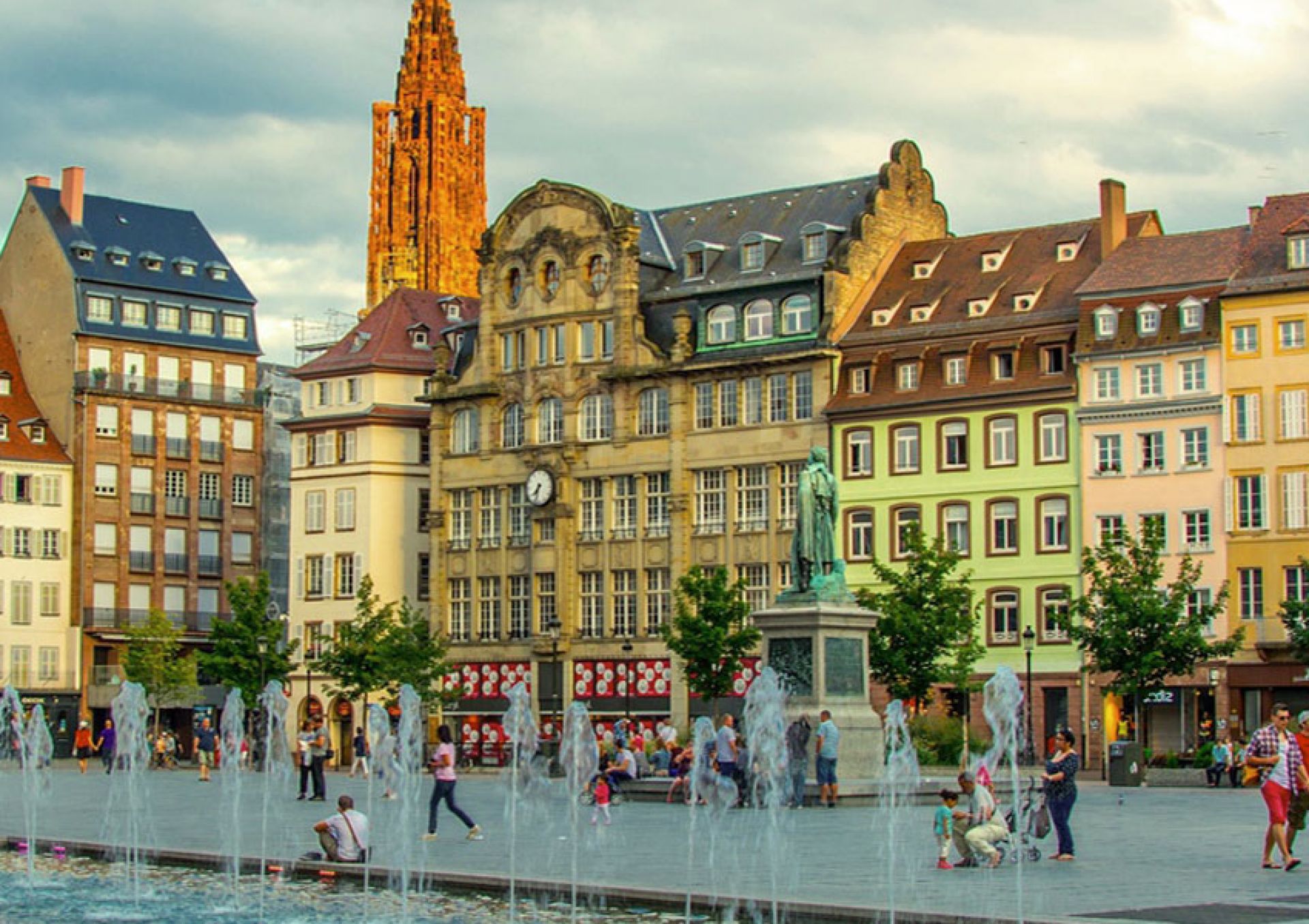
Kleber Square in Strasbourg (Place Kleber)
Strasbourg and surrounding
Squares, Parks, Gardens
Address: Place Kleber
The first to walk across the square were the barefoot nuns because a church and an adjacent poverty-stricken Franciscan monastery were standing nearby. Monks in gray robes, belted with twine, lived exclusively on alms and often shared the word of God by their monastery. Therefore, the first name of Place Kleber was Barfusserplatz (“square of the barefoot”). In the 18th century, marching squads replaced the monks. In one of the buildings, the city barracks for security guards and a guardhouse were located. The square was renamed Waffenplatz (“arms square”).
The vast red neoclassical building, more specifically the Aubette Palace, has a complicated backstory. Built for the military, 100 years later, it burned to the ground during the siege of Strasbourg by the Prussian troops. The palace was restored, a symbolic statue of Music and bas-reliefs of composers (Bach, Mozart, Mendelssohn) were placed on the fronton. A conservatory was opened.
The square received its current name in 1840 when the remains of General Jean-Baptiste Kleber, a native of Strasbourg and an associate of Napoleon, were buried there. The general became famous for his successes in the Egyptian campaign in 1800, having recaptured Upper Egypt from the British. Unfortunately, the locals didn’t accept the new ruler, and an Egyptian fanatic killed the general.
The square monument depicts Kleber standing with a letter in his hand. After reading a proposal of the British to surrender, he said, “The only answer to such audacity shall be victory. Soldiers, get ready to fight!”
Tourists and especially citizens love the square. If you see many chewing people on a pedestal around the monument in good weather, don’t be surprised. There is a lovely urban tradition: to dine by Kleber with a baguette with cheese or a hot dog. The narrowest house in Strasbourg is also located on the square. Its width is only two meters, and a jewelry store is located on its ground floor. A gallery of shops has replaced the conservatory at the Aubette Palace. A distinctly modern building with a logged square roof that falls out of the picture is a shopping mall, built in 1978 in place of the legendary hotel that received Charles de Gaulle and Winston Churchill.
Strasbourg is the king of Christmas markets in Alsace. The highest, 30-meter Christmas tree in the district is erected on Place Kleber when the Christmas village is buzzing around. Traditionally, the city donates the incomings to charity.
